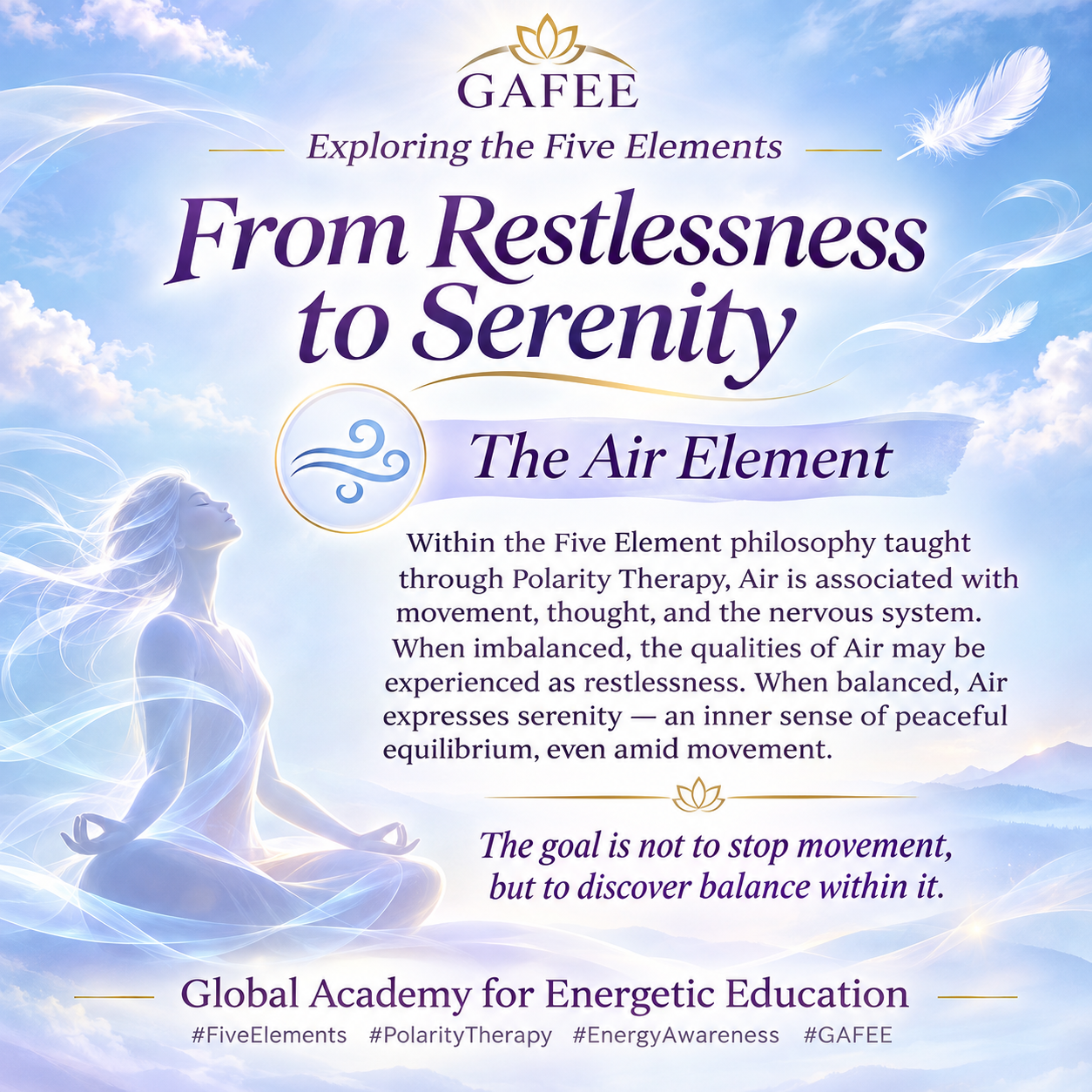
Exploring the Five Elements through Polarity Therapy
Have you ever noticed how difficult it can be to feel still, even when your body is perfectly at rest?
Perhaps your thoughts are moving from one subject to another, your attention is scattered, or you experience an underlying urge to do something, change something, or move on to whatever comes next.
This experience of restlessness offers an interesting opportunity to explore the Air element within the Five Element philosophy of Polarity Therapy.
But what if the goal isn't to eliminate movement?
What if true serenity is the ability to experience peace within movement?
Understanding the Air Element
Within Polarity Therapy, the Five Elements—Ether, Air, Fire, Water, and Earth—provide a philosophical framework for exploring energetic patterns and their relationships to our physical, emotional, and mental experiences.
Each element expresses particular qualities, tendencies, and patterns. Through self-awareness, we can begin to recognize how these qualities may be reflected in our everyday lives.
Air is associated with movement, communication, thought, and the nervous system.
Just as the air around us is constantly moving, the qualities associated with the Air element reflect activity, exchange, and change.
Movement itself is neither positive nor negative. In fact, it is an essential part of life.
The question becomes: How do we experience that movement?
Restlessness: When Movement Loses Its Balance
Restlessness is not necessarily the same as physical activity.
A person may be physically active while experiencing a profound sense of inner peace. Conversely, someone sitting quietly may experience a constant stream of thoughts, distractions, or an inability to settle into the present moment.
Within the philosophical framework of the Five Elements, restlessness can be understood as an expression of Air when its natural movement becomes unbalanced.
This may be experienced as:
Difficulty remaining present
Excessive mental activity or scattered attention
A persistent feeling of needing to do something
Difficulty settling into rest
An underlying sense of uneasiness, even when circumstances are peaceful
These experiences are not necessarily problems to be eliminated. Rather, they may serve as invitations to develop greater awareness.
Instead of immediately trying to change what we are experiencing, we might begin by simply observing it.
What is moving within us?
What seems to be driving that movement?
And perhaps most importantly, can we become aware of the movement without becoming consumed by it?
Serenity: Finding Peace Within Movement
When we think of serenity, we often imagine complete stillness: a quiet room, a peaceful landscape, or a mind free from distraction.
But within the Air element, serenity offers a more dynamic possibility.
Serenity does not require the absence of movement. It represents peaceful inner equilibrium amid movement.
Thoughts may continue to arise. Life may remain busy. Circumstances may change.
Yet our internal experience does not have to be dictated by every thought, sensation, or external event.
This distinction is particularly meaningful because it suggests that balance is not necessarily achieved by controlling our environment or eliminating activity.
Instead, serenity may emerge through our relationship with the movement itself.
We can remain engaged with life without feeling internally scattered by it.
We can experience change without losing our sense of balance.
We can allow thoughts to move without needing to follow every one of them.
Serenity becomes less about creating perfect conditions and more about cultivating awareness within the conditions that already exist.
Serenity and Neutrality: An Important Distinction
Within the Five Element philosophy, it is also valuable to distinguish the serenity associated with Air from the neutrality associated with Ether.
Although these qualities may appear similar, they express different aspects of energetic balance.
Ether's neutrality reflects spaciousness, openness, and the capacity to observe without attachment or judgment.
Air's serenity, on the other hand, reflects peaceful equilibrium within movement and activity.
We might think of Ether as the spacious awareness in which experience occurs, while Air represents the ability to remain peacefully balanced as experiences move and change.
Both offer valuable perspectives on self-awareness, but they are not interchangeable.
Recognizing these distinctions helps us develop a more nuanced understanding of the Five Elements and their practical applications.
Bringing Awareness Into Everyday Life
One of the most valuable aspects of studying the Five Elements is the opportunity to apply their principles to everyday experiences.
Consider a moment when you feel restless.
Rather than immediately reaching for a distraction or attempting to force yourself into stillness, you might explore a few questions:
Is the restlessness primarily physical, mental, or emotional?
Am I responding to something happening around me, or to something occurring within me?
What happens when I observe this experience without judging it?
Can I allow movement to exist while remaining internally peaceful?
These questions are not intended to produce a particular answer.
Their purpose is to encourage curiosity and deepen self-awareness.
You might also explore gentle movement, stretching, breathing awareness, or spending time outdoors as opportunities to observe your experience of movement and stillness.
The intention is not to suppress restlessness or force serenity into existence.
It is to become more conscious of how we are experiencing ourselves.
The Role of Self-Awareness in Polarity Therapy
Self-Awareness is one of the Four Branches of Polarity Therapy, alongside Bodywork, Stretches & Postures, and Energetic Food Awareness.
Through the study of these interconnected branches, students are encouraged to explore relationships among energetic principles, physical experiences, lifestyle choices, and conscious awareness.
The Five Element philosophy provides one framework for this exploration.
Rather than viewing balance as a permanent state that must be achieved, we can begin to recognize it as an ongoing and dynamic relationship.
Our experiences change. Our thoughts change. Our circumstances change.
And through greater awareness, we may discover new ways of relating to those changes.
A Different Perspective on Balance
Perhaps one of the most meaningful lessons of the Air element is that movement and peace are not opposites.
We do not necessarily need to slow down every aspect of life to experience serenity.
Nor do we need to eliminate every restless thought before we can feel balanced.
Instead, we can explore the possibility of becoming more conscious participants in our own experiences.
The goal is not to stop movement, but to discover balance within it.
And sometimes, that discovery begins with something as simple as noticing what is happening within us.
Explore the Five Elements at GAFEE
At the Global Academy for Energetic Education (GAFEE), the Five Element philosophy is an integral part of our educational approach to Polarity Therapy and holistic health.
Through classroom instruction, experiential learning, and self-awareness practices, students explore energetic principles and their applications within a comprehensive educational framework.
We invite you to learn more about our Polarity Therapy training and holistic health education programs and discover how the study of energy can expand your understanding of yourself and the world around you.